
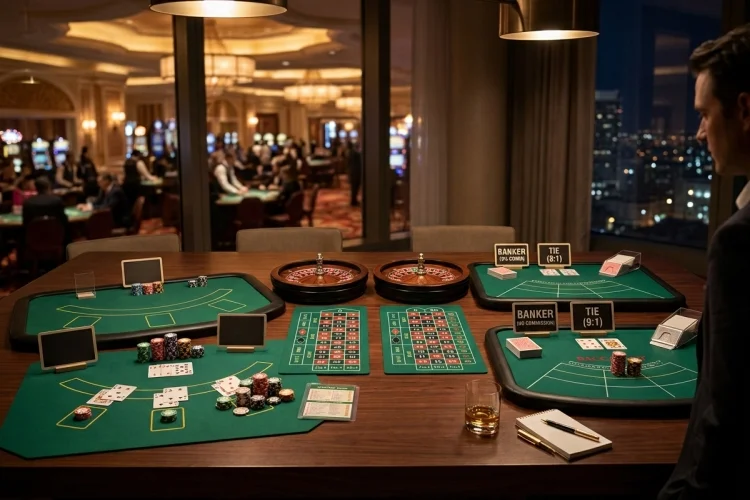
How the House Edge Works Across Popular Table Games
Table games are often compared using simple labels. Blackjack may be described as a low-edge game, roulette as easy to understand, and baccarat as a game with straightforward wagers.
These descriptions are useful, but they leave out an important detail: a game does not always have one universal house-edge percentage.
The casino advantage can change according to the wager, payout table, wheel type, card rules, commission system, and player decisions.
A Banker bet and a Tie bet may appear on the same baccarat table, yet their mathematical costs are dramatically different. Similarly, a blackjack table paying 6 to 5 is not equivalent to one paying 3 to 2.
Learning how the house edge works in table games therefore requires comparing specific rules rather than game names alone. Players should also consider pace.
A small edge applied to hundreds of wagers can create greater expected exposure than a larger edge applied only a few times.
Why One Game Can Have Several House Edges
Each table-game wager has its own probability of winning and payout amount. The house edge appears when the prize is lower than the mathematically fair return for that probability.
Casinos can offer many wagers because different combinations of probability and payout still preserve an advantage for the operator. Some bets produce small, frequent prizes, while others offer rare but larger awards.
Regulatory guidance in Great Britain requires relevant game descriptions, payout information, and house-edge or RTP details to be made available so customers can make informed decisions.
European and American Roulette
Roulette provides a useful comparison because most standard wagers on the same wheel carry an identical edge. A straight-up number pays 35 to 1, while red, black, odd, and even wagers pay even money.
On a single-zero European wheel, the casino advantage is approximately 2.70%. On a double-zero American wheel, it rises to approximately 5.26%.
The extra zero nearly doubles the house edge even though the familiar wagers retain the same payouts. The five-number American wager covering 0, 00, 1, 2, and 3 is even less favorable, with an edge of approximately 7.89%.
Blackjack Can Offer a Low Edge With Suitable Rules
Blackjack’s house edge cannot be summarized without stating the rules and strategy assumptions. The number of decks, dealer behavior, splitting permissions, surrender, and natural-blackjack payout all affect expected return.
Mathematical calculators show that blackjack can have a relatively small casino advantage under favorable rules when the player follows an appropriate basic strategy. The exact percentage changes whenever the conditions change.
A 6-to-5 natural payout is particularly important to identify. Compared with 3 to 2, the reduced payout can add approximately 1.39 percentage points to the edge under otherwise comparable conditions.
Banker, Player, and Tie in Baccarat
Baccarat involves fewer player decisions because the drawing rules are automatic. Participants normally choose Banker, Player, or Tie before the cards are dealt.
In a standard eight-deck game, the Banker wager carries an approximate edge of 1.06%, while Player is around 1.24%. Banker wins commonly pay less than even money because a commission is deducted.
The Tie bet may look appealing because of its larger payout, but its standard edge is approximately 14.36% when it pays 8 to 1. Pair and other optional wagers can also carry substantially larger margins than the main bets.
Craps Rewards Careful Bet Selection
The craps table contains wagers with widely different expected values. Pass Line and Don’t Pass are among the more mathematically favorable starting options.
The standard Pass Line edge is about 1.41%. The Don’t Pass figure is slightly lower, although published values can vary depending on whether a push on 12 is counted as a wager that was resolved.
After a point has been established, players may be allowed to place an additional odds wager. Because odds bets pay at the true probability, they have no independent house edge. With full 3x-4x-5x odds, the combined edge relative to all money wagered can fall below 0.4%.
Side Bets Usually Change the Comparison
Side bets provide additional outcomes beyond the main game. Examples include blackjack pairs, baccarat pairs, roulette bonus sections, and progressive table jackpots.
These wagers often advertise large prizes but may have a higher house edge than the base game. A player choosing blackjack for its relatively low edge can therefore create much greater expected exposure by repeatedly adding expensive side wagers.
The largest possible payout is not enough information for evaluating value. Players must also know the probability of winning and how frequently the side bet is resolved.
Game Speed Affects Expected Exposure
House edge measures expected loss relative to money wagered, not necessarily loss per hour. A game with a 1% edge does not have the same practical cost at every pace.
Suppose a player makes fifty $10 wagers per hour at a 1% edge. The theoretical hourly loss is approximately $5:
$10 × 50 × 1% = $5
If the same game processes 150 wagers, the estimate becomes $15. Actual results will still vary widely, but faster play increases total turnover and repeatedly exposes the bankroll to the mathematical disadvantage.
Look Beyond the Headline Percentage
House edge is a valuable comparison tool, but it does not fully describe risk. It does not show the probability of losing the entire session bankroll, the size of possible swings, or the emotional effect of repeated wins and losses.
In games where players can increase the original wager, such as doubling in blackjack, calculating exposure can also become more complicated. The conventional house-edge figure is normally based on the initial wager rather than every additional amount placed later.
Players should combine the percentage with information about volatility, betting limits, session duration, and personal affordability.
Popular table games do not have one universal house edge. Roulette changes according to the wheel, blackjack depends on rules and decisions, baccarat offers main and side bets with very different margins, and craps ranges from true-odds wagers to expensive proposition bets.
Game speed also matters because every completed wager adds to total turnover. A modest edge can still produce meaningful expected losses during a fast or lengthy session.
Before playing, compare the exact wager rather than the game’s name. Read the payout table, avoid assuming that larger prizes offer better value, and calculate how much money may be wagered over the full session. Establish strict spending and time limits before placing the first bet.