

Tag: Table Games

Casino Games

Classic Casino Games: How Traditional Favorites Evolved for Today

A blackjack table from decades ago and a live blackjack stream on a smartphone may look completely different, but they are built around the same card values and basic objective. Roulette, baccarat, craps, poker, and slots have followed a similar path.

Instead of disappearing when casinos became more digital, Classic Casino Games adapted.

Major physical casinos still offer traditional table formats, while modern providers stream familiar games from professional studios and reproduce others through electronic terminals or RNG software.

The interesting question is not why the classics vanished, but how they successfully changed.

Traditional Casino Floors Still Matter

Digital gambling has expanded enormously, but the physical casino table has not become obsolete.

Walk through a current Las Vegas casino and the familiar names are still there. MGM Grand lists blackjack, baccarat, craps, roulette, and several poker formats, while The Venetian describes baccarat, blackjack, and roulette as part of its selection of classic casino table games.

The Cosmopolitan similarly continues to offer blackjack, roulette, craps, baccarat, and several poker-based games.

Physical tables provide something difficult to duplicate entirely on a screen: people sharing the same space.

That matters particularly for craps, poker, and dealer games where interaction contributes to the atmosphere.

The traditional casino floor therefore became one branch of a much wider ecosystem rather than being replaced outright.

Blackjack Became Faster and More Flexible Online

Classic blackjack usually uses a limited number of seats around a dealer.

Live technology removed some of those physical limitations.

Evolution’s standard live blackjack still resembles a traditional seven-seat table, but its Infinite Blackjack format allows an unlimited number of participants to receive a common starting hand before making their own decisions independently.

Other versions add faster decision systems, multipliers, or additional side wagers.

Yet the core objective remains familiar: produce a valid hand stronger than the dealer’s without busting.

That familiarity lowers the learning barrier. Someone who understands traditional blackjack can usually recognise the basic structure even when a modern version adds extra mechanics.

The new features change the experiance, not the identity of the game.

Roulette Was Almost Made for Digital Screens

Roulette already has a naturally visual format.

The wheel spins, the ball moves, and players watch one numbered pocket determine the result.

That made the game well suited to live streaming.

Evolution’s current online portfolio includes standard roulette alongside variations that introduce new features, while casino properties such as Bellagio still present the traditional physical wheel and betting layout.

Electronic table games offer another adaptation.

MGM National Harbor currently provides hybrid electronic products where players use individual terminals while participating in dealer-supported versions of games including roulette, blackjack, and baccarat.

This format changes how bets are entered but preserves the underlying result.

Whether chips are physically placed on felt or tapped onto a touchscreen layout, the player is still predicting the roulette outcome.

Baccarat Became Accessible Beyond High-Limit Rooms

Baccarat has long carried an image of formal tables and higher-stakes casino areas.

Digital formats changed that presentation considerably.

The essential game remains focused on Player, Banker, and Tie outcomes, with drawing rules determining how each hand develops.

Live baccarat now appears across numerous online tables, sometimes with lower minimums, configurable side bets, multiple camera views, and statistics displayed directly on the interface.

Evolution’s current portfolio includes standard baccarat as well as variations such as Peek Baccarat and Lightning Baccarat.

Physical casinos have evolved the game too. Beau Rivage currently promotes a no-commission baccarat variation alongside traditional versions.

Baccarat therefore shows how a classic can keep its basic rules while changing its pacing, presentation, and betting options.

Craps Expanded Into Electronic and Online Formats

Craps once seemed especially difficult to translate away from a physical casino.

The game revolves around a shooter rolling dice while a group of players follows the action around a large betting layout.

Yet the core mechanic is ultimately mathematical: dice totals determine what happens to active bets.

That made electronic adaptation possible.

MGM National Harbor currently offers electronic gaming formats linked to games such as craps, alongside regular physical tables. Evolution also includes live Craps among its digital live-casino categories.

The online interface can even make the complicated layout easier for some beginners because valid betting positions and payouts can be displayed interactively.

The atmosphere may be diferent, but the familiar come-out roll, point, and seven-out concepts still anchor the game.

Slots Moved From Mechanical Reels to Software

The transition of slot machines is perhaps the clearest example of technological evolution.

Historic machines were mechanical devices built from metal, glass, springs, reels, and coin mechanisms. The Smithsonian preserves examples from manufacturers such as Mills Novelty Company, including machines dating to the 1930s and 1950s.

Today, slots are usually electronic.

Digital technology allows developers to create animated reels, cascading symbols, expanding grids, free spins, jackpots, multipliers, and interactive bonuses that would have been impossible on a purely mechanical machine.

Yet the core action remains remarkably familiar.

A wager starts a game cycle and the final arrangement determines the result according to the game’s rules.

That continuity is one reason modern slots can look radically new while still feeling recognisably like slot machines.

Poker Adapted Without Losing the Human Element

Poker faced a different challenge.

Much of its identity comes from competition between players, making human decision-making central rather than optional.

Online poker solved the physical-space problem by replacing chips and cards with a digital interface while preserving betting rounds, hand rankings, and player decisions.

Casinos also developed more house-banked poker variants.

MGM Grand currently offers traditional poker alongside games such as Three Card Poker, Ultimate Texas Hold’em, Pai Gow Poker, and Let It Ride Poker.

Live casino technology has added another branch, bringing dealer-hosted poker-style games onto streamed platforms. Evolution’s portfolio also continues to list poker among its core live-casino categories.

So poker did not evolve in one direction. It split into poker rooms, online multiplayer games, dealer-based table variants, and live-streamed formats.

Why Classic Formats Adapt So Well

The most durable casino games have a strong central mechanic.

Blackjack revolves around 21. Roulette revolves around the wheel. Baccarat compares Player and Banker. Craps uses dice sequences. Poker uses card rankings and decisions, while slots revolve around reel outcomes.

Those foundations are easy to recognize even after developers add new technology.

Evolution’s current product range explicitly combines classic roulette, blackjack, baccarat, poker, and craps with newer digital variations and live game shows. Meanwhile, major physical casino operators continue offering many of the same traditional games on their floors.

That coexistence suggests adaptation rather than replacement.

New presentation can attract attention, but familiar rules give players something immediately understandable underneath.

Classic Casino Games survived technological change because their basic mechanics are flexible.

Cards can be dealt physically or streamed, roulette bets can be placed with chips or touchscreen controls, and slots can move from mechanical reels to sophisticated software.

If you want to understand modern casino games, learn their classic foundations first. Once the original rules make sense, electronic, live dealer, and feature-rich variations become much easier to follow.
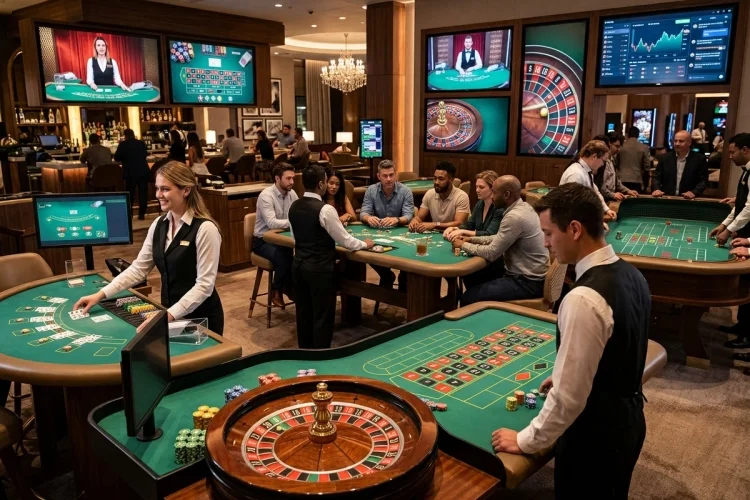
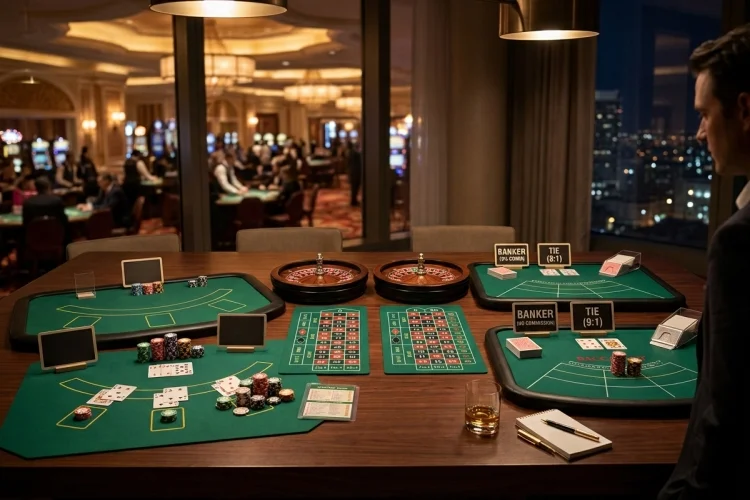
Table Games

The Most Popular Table Games in Online Casinos for Beginners

A new online casino player may recognize the names blackjack, roulette, baccarat, poker, and craps without knowing how differently these games operate.

Some require decisions after the wager is placed, while others resolve according to fixed rules. Certain tables are easy to understand within minutes, whereas others contain numerous betting areas and optional side wagers.

Learning about the most popular table games in online casinos can make the first visit less confusing. It helps beginners identify which games involve cards, wheels, dice, human dealers, or random number generator software.

It also makes it easier to understand why a visually simple game can still contain complex payout conditions. Available research from Great Britain illustrates the broad appeal of these products.

One UK Gambling Commission study found virtual roulette was the most frequently played non-slot online casino game among its respondents, followed by poker and live roulette. Virtual and live blackjack were also widely used in the surveyed group.

Start With the Amount of Decision-Making

The easiest way to compare table games is to ask how many decisions the player must make after the round begins.

In blackjack, the participant chooses whether to request another card, stand, double, split, or sometimes surrender. Roulette and baccarat require fewer mid-round decisions because the player selects a wager before the result is produced.

Poker can involve considerably more decision-making, especially when customers compete against one another. Craps occupies the middle ground: the dice determine the result, but the table offers many separate betting options.

Blackjack for Players Who Enjoy Card Decisions

The goal of blackjack is to beat the dealer with a hand closer to 21 without going over. Players receive an initial hand and decide how to continue based on their total and the dealer’s visible card.

Aces can normally count as one or eleven, while tens and picture cards count as ten. A total above 21 is a bust and usually loses immediately.

Before playing, beginners should check whether a natural blackjack pays 3 to 2 or 6 to 5. They should also review the dealer’s rules, the number of decks, and whether doubling or splitting is restricted.

Roulette for Straightforward Bet Placement

Roulette may be suitable for beginners who want simple round procedures but several wager choices. The player places chips on a layout, the wheel produces a number, and winning wagers are paid according to their positions.

Inside bets cover individual numbers or small groups and generally offer larger payouts. Outside bets cover categories such as red or black, odd or even, columns, or dozens.

European roulette includes one zero, while American roulette traditionally includes both zero and double zero. This difference changes the mathematical conditions even though many payouts remain identical.

Baccarat for Minimal Playing Decisions

Baccarat has a formal appearance, but the main betting decision is relatively simple. Players usually wager on Banker, Player, or Tie.

The dealer follows fixed procedures for drawing additional cards. Participants do not normally decide whether either hand should hit or stand.

The objective is to identify which hand will finish closest to nine. Banker wins may carry a commission, and Tie or pair bets use different payouts.

Beginners should avoid assuming that the highest advertised payout provides the best mathematical value. Every wager should be evaluated separately.

Poker for Competition and Longer Sessions

Peer-to-peer poker differs from most online casino games because participants compete against other customers instead of directly against the house. The operator provides the platform and may collect a rake or tournament fee.

This format involves hand rankings, betting rounds, position, bluffing, and opponent behavior. It can therefore require more preparation than blackjack or baccarat.

Casino poker games such as three-card poker follow another structure. In those versions, the player usually compares a hand with the dealer or a fixed qualification rule rather than playing against other customers.

Craps for Players Who Like Betting Variety

Craps uses two dice and a large table layout. The Pass Line is one of the main starting wagers.

On the come-out roll, seven or eleven wins the Pass Line bet, while two, three, or twelve loses it. Other qualifying totals establish a point that must be repeated before seven.

The table may also offer Come bets, place bets, field wagers, hardways, proposition bets, and odds. Beginners should learn one or two basic wagers before trying to interpret the entire layout.

Virtual Tables Versus Live Dealers

Virtual table games generally use RNG software and animated cards, wheels, or dice. They can resolve rounds quickly and are often available at lower betting limits.

Live dealer games use streamed human dealers and physical equipment. Regulatory guidance explains that fair shuffling, dealing procedures, roulette-wheel integrity, and equipment controls form part of live-game oversight.

Neither version guarantees more favorable results. Virtual tables may appeal to players who prefer speed, while live games may suit those who value a social atmosphere and a more traditional pace.

Check Rules, Pace, and Total Spending

Game pace can affect total exposure. Faster tables allow more wagers to be completed during the same period, even when the stake per round appears small.

In the UK Gambling Commission study, most respondents considered the speed of the surveyed online table games appropriate.

However, 24% reported spending more than they could afford to lose, demonstrating why popularity and entertainment value must be balanced with limits.

Players should monitor the total amount wagered rather than only the starting deposit. Reusing winnings across many rounds can create a much larger turnover than the original balance suggests.

The best table game for a beginner depends on the preferred level of decision-making and complexity. Blackjack involves repeated card choices, roulette offers straightforward bet placement, and baccarat follows automatic drawing rules.

Poker introduces competition with other participants, while craps provides extensive betting variety.

Beginners should not choose a table solely because it is popular or visually impressive. The exact rules, payouts, speed, and minimum stake are more important than the game’s name.

Read the full help section before placing a real-money wager. Start with simple options, avoid unfamiliar side bets, and establish clear spending and time limits. Stop once either limit is reached, regardless of whether the session is winning or losing.

Table Games

How the House Edge Works Across Popular Table Games

Table games are often compared using simple labels. Blackjack may be described as a low-edge game, roulette as easy to understand, and baccarat as a game with straightforward wagers.

These descriptions are useful, but they leave out an important detail: a game does not always have one universal house-edge percentage.

The casino advantage can change according to the wager, payout table, wheel type, card rules, commission system, and player decisions.

A Banker bet and a Tie bet may appear on the same baccarat table, yet their mathematical costs are dramatically different. Similarly, a blackjack table paying 6 to 5 is not equivalent to one paying 3 to 2.

Learning how the house edge works in table games therefore requires comparing specific rules rather than game names alone. Players should also consider pace.

A small edge applied to hundreds of wagers can create greater expected exposure than a larger edge applied only a few times.

Why One Game Can Have Several House Edges

Each table-game wager has its own probability of winning and payout amount. The house edge appears when the prize is lower than the mathematically fair return for that probability.

Casinos can offer many wagers because different combinations of probability and payout still preserve an advantage for the operator. Some bets produce small, frequent prizes, while others offer rare but larger awards.

Regulatory guidance in Great Britain requires relevant game descriptions, payout information, and house-edge or RTP details to be made available so customers can make informed decisions.

European and American Roulette

Roulette provides a useful comparison because most standard wagers on the same wheel carry an identical edge. A straight-up number pays 35 to 1, while red, black, odd, and even wagers pay even money.

On a single-zero European wheel, the casino advantage is approximately 2.70%. On a double-zero American wheel, it rises to approximately 5.26%.

The extra zero nearly doubles the house edge even though the familiar wagers retain the same payouts. The five-number American wager covering 0, 00, 1, 2, and 3 is even less favorable, with an edge of approximately 7.89%.

Blackjack Can Offer a Low Edge With Suitable Rules

Blackjack’s house edge cannot be summarized without stating the rules and strategy assumptions. The number of decks, dealer behavior, splitting permissions, surrender, and natural-blackjack payout all affect expected return.

Mathematical calculators show that blackjack can have a relatively small casino advantage under favorable rules when the player follows an appropriate basic strategy. The exact percentage changes whenever the conditions change.

A 6-to-5 natural payout is particularly important to identify. Compared with 3 to 2, the reduced payout can add approximately 1.39 percentage points to the edge under otherwise comparable conditions.

Banker, Player, and Tie in Baccarat

Baccarat involves fewer player decisions because the drawing rules are automatic. Participants normally choose Banker, Player, or Tie before the cards are dealt.

In a standard eight-deck game, the Banker wager carries an approximate edge of 1.06%, while Player is around 1.24%. Banker wins commonly pay less than even money because a commission is deducted.

The Tie bet may look appealing because of its larger payout, but its standard edge is approximately 14.36% when it pays 8 to 1. Pair and other optional wagers can also carry substantially larger margins than the main bets.

Craps Rewards Careful Bet Selection

The craps table contains wagers with widely different expected values. Pass Line and Don’t Pass are among the more mathematically favorable starting options.

The standard Pass Line edge is about 1.41%. The Don’t Pass figure is slightly lower, although published values can vary depending on whether a push on 12 is counted as a wager that was resolved.

After a point has been established, players may be allowed to place an additional odds wager. Because odds bets pay at the true probability, they have no independent house edge. With full 3x-4x-5x odds, the combined edge relative to all money wagered can fall below 0.4%.

Side Bets Usually Change the Comparison

Side bets provide additional outcomes beyond the main game. Examples include blackjack pairs, baccarat pairs, roulette bonus sections, and progressive table jackpots.

These wagers often advertise large prizes but may have a higher house edge than the base game. A player choosing blackjack for its relatively low edge can therefore create much greater expected exposure by repeatedly adding expensive side wagers.

The largest possible payout is not enough information for evaluating value. Players must also know the probability of winning and how frequently the side bet is resolved.

Game Speed Affects Expected Exposure

House edge measures expected loss relative to money wagered, not necessarily loss per hour. A game with a 1% edge does not have the same practical cost at every pace.

Suppose a player makes fifty $10 wagers per hour at a 1% edge. The theoretical hourly loss is approximately $5:

$10 × 50 × 1% = $5

If the same game processes 150 wagers, the estimate becomes $15. Actual results will still vary widely, but faster play increases total turnover and repeatedly exposes the bankroll to the mathematical disadvantage.

Look Beyond the Headline Percentage

House edge is a valuable comparison tool, but it does not fully describe risk. It does not show the probability of losing the entire session bankroll, the size of possible swings, or the emotional effect of repeated wins and losses.

In games where players can increase the original wager, such as doubling in blackjack, calculating exposure can also become more complicated. The conventional house-edge figure is normally based on the initial wager rather than every additional amount placed later.

Players should combine the percentage with information about volatility, betting limits, session duration, and personal affordability.

Popular table games do not have one universal house edge. Roulette changes according to the wheel, blackjack depends on rules and decisions, baccarat offers main and side bets with very different margins, and craps ranges from true-odds wagers to expensive proposition bets.

Game speed also matters because every completed wager adds to total turnover. A modest edge can still produce meaningful expected losses during a fast or lengthy session.

Before playing, compare the exact wager rather than the game’s name. Read the payout table, avoid assuming that larger prizes offer better value, and calculate how much money may be wagered over the full session. Establish strict spending and time limits before placing the first bet.