
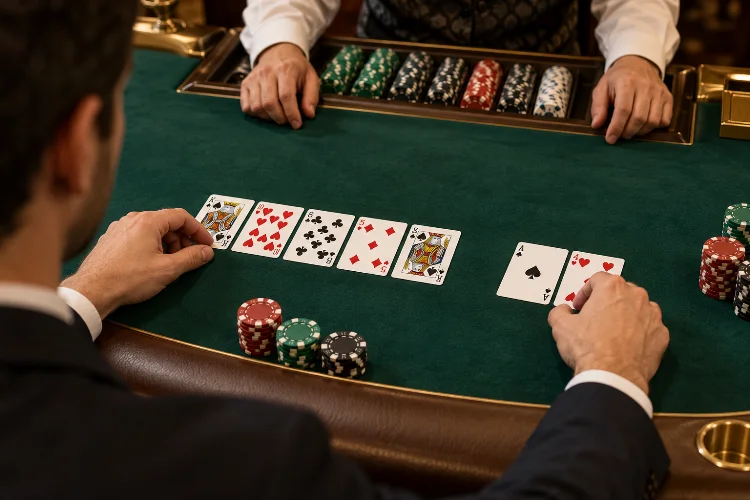
Pai Gow Poker Rules and Basic Gameplay: How Each Round Works
Pai Gow Poker feels unusual because winning is not just about making the strongest five-card poker hand possible. You also need to reserve enough strength for a second, two-card hand. Make one side too strong and the other can become easy for the banker to beat.
Understanding Pai Gow Poker Rules and Basic Gameplay is therefore mostly about balance. The cards themselves use familiar poker concepts, but the split-hand structure changes how you think about them.
This guide walks through a typical round and explains the rules beginners are most likely to encounter at a traditional casino table.
Step 1: Seven Cards Are Dealt
Pai Gow Poker traditionally uses one standard 52-card deck plus a joker, creating a 53-card pack.
After wagers are placed, seven cards are dealt to each participating hand and the banker.
At this point, you are not drawing additional cards as you would in some poker games.
Your entire job is to arrange the seven cards you already have.
Every card must belong to one of two hands:
a five-card high hand and a two-card low hand.
The casino may use different terms such as back and front, bottom and top, or high and low. Despite the terminology, the same basic idea applies.
Step 2: Build the Five-Card and Two-Card Hands
The five-card hand uses normal poker rankings.
The two-card hand can only form a pair or a high-card combination.
There is one important restriction: the five-card hand cannot be weaker than the two-card hand.
This creates the central decision in Pai Gow Poker.
Imagine receiving:
A♠, A♦, K♣, J♥, 9♣, 6♦, 3♠.
The obvious five-card strength is the pair of aces. You might therefore keep the aces in the five-card hand and put K-J in the two-card hand.
That creates a reasonably strong front while preserving your pair behind.
The best arrangement is not always obvious, especially when you receive two pairs, three of a kind, or several possible straights.
Step 3: Understand What the Joker Can Do
The joker causes plenty of beginner confusion.
In conventional Nevada-style Pai Gow Poker, it is semi-wild, not completely wild.
It can normally function as an ace. Alternatively, it can complete a straight, flush, straight flush, or royal flush.
For example, suppose you hold 6-7-8-9 plus the joker.
The joker can represent the ten needed to finish the straight.
But if you hold K-K-8-5 plus the joker, you cannot simply declare the joker another king under the standard semi-wild rule. It would generally function as an ace instead.
There are exceptions because some California games and special variants use a fully wild joker.
Check the table before applying a rule learned elsewhere.
Step 4: The Dealer Uses the House Way
Players decide how to arrange their cards, but the dealer generally follows a fixed method known as the house way.
This is basically an internal strategy chart.
With no pair, a common house-way approach places the second- and third-highest cards in the two-card hand. With one pair, the pair commonly stays behind while the highest two remaining cards move to the front.
More difficult situations involve two pairs.
Should two pairs remain together to create a strong five-card hand? Or should one pair move forward, creating strength on both sides?
House-way charts answer these questions using rules based on pair strength and available kickers.
The precise chart is not identical everywhere, which is another reason “the house way” should not be treated as one universal strategy.
Step 5: Both Hands Are Compared Separately
Once everybody has set their cards, the dealer reveals and arranges the banker’s hand.
Then two comparisons happen.
Your two-card hand goes against the banker’s two-card hand. Your five-card hand goes against the corresponding five-card hand.
Suppose you have:
Two-card hand: K-Q
Five-card hand: 8-8-8-6-3
The banker has:
Two-card hand: A-10
Five-card hand: J-J-9-7-4
Your three of a kind beats the banker’s pair, so you win the five-card comparison.
However, A-10 beats K-Q in the two-card comparison.
The result is therefore a push: you win one side and the banker wins the other.
No profit, but no main-wager loss either.
Step 6: You Need Both Hands to Win the Wager
To win the standard main bet, both of your hands normally need to defeat the banker’s corresponding hands.
Winning only one is not enough.
This creates an interesting strategic problem.
Making an extremely strong five-card hand can sometimes be less useful if doing so leaves your two-card hand almost certain to lose.
For instance, keeping two pairs together behind might create a strong high hand. Splitting those pairs could sometimes produce a pair in each hand, potentially giving you a better chance of winning both comparisons.
That does not mean pairs should always be split.
Hand-setting decisions depend on the exact cards and rules being used.
Beginners who are uncertain can often ask how the casino’s house way would arrange the cards. That is a useful learning tool, although it is not necessarily mathematically optimal in every situation.
Step 7: Remember That Copies Favor the Banker
One of the most distinctive rules is what happens when identical-value hands meet.
The banker generally wins an exact tie, known as a copy.
Imagine both two-card hands are K-J.
That comparison belongs to the banker.
If your five-card hand beats the banker’s, the overall main wager generally pushes. If your five-card hand also ties or loses, you lose the wager.
This tie advantage is one reason the distinction between dealer and banker matters.
The dealer is the person physically operating the game. The banker is the side whose position receives the copy advantage and stands against the other wagers.
Often the house banks, but traditional rules can also allow players to bank.
Traditional Wins Usually Carry a Commission
Conventional Pai Gow Poker usually pays a winning main bet at even money less a 5% commission.
So if you wager $20 and win, the gross win would be $20, with $1 representing a 5% commission, leaving $19 in profit.
Bellagio’s published gaming guide confirms the traditional 5% structure.
However, plenty of modern tables are marketed as commission-free.
That does not mean the house has simply removed its advantage.
Commission-free variants usually introduce another special condition. In one documented version, for example, dealer nine-high in the low hand causes an automatic push. EZ Pai Gow uses another push condition based around a dealer queen-high hand.
Read the modification before assuming “no commission” means the standard game with a free upgrade.
Why Pai Gow Produces So Many Pushes
Pai Gow Poker has a reputation for producing a lot of pushes because players are effectively competing twice in each round.
It is easy to create situations where one side wins the five-card battle while the other wins the two-card comparison.
This gives the game a different rhythm from blackjack or baccarat.
Your bankroll may move more slowly simply because some rounds finish with neither a win nor a loss on the main wager.
That does not mean pushes are automatically favourable.
The house still has structural advantages, including banker treatment of exact ties under conventional rules and commission or alternative rules depending on the version.
The slower pace is an experiance characteristic, not proof that the game has no mathematical cost.
Side Bets Are Separate From the Main Game
Many modern Pai Gow tables include optional side wagers.
Fortune Pai Gow is one example. Instead of comparing your two arranged hands against the banker, the Fortune side bet evaluates the strength of your seven-card collection according to its own paytable. Caesars describes payouts tied to qualifying hands and an optional Envy feature.
These side wagers are separate from the basic game.
You can potentially lose the main wager while winning a side bet, or win the standard game while losing the optional wager.
Beginners are usually better served by learning the main two-hand comparison first.
Adding side bets before understanding the core rules can make a fairly straightforward game appear much more complicated than it is.
Pai Gow Poker Rules and Basic Gameplay become much easier once you think of the game as two poker contests happening at the same time.
Build a legal five-card hand, balance it with your two-card hand, and try to beat the banker in both comparisons.
Before wagering, check the joker rules, house way, commission, banking procedure, and any special push conditions so you know exactly which Pai Gow version you are playing.