
Online Slots

What Is a Slot Maximum Win? Multipliers, Caps, and Bonus Features

Slot games love big numbers. One might advertise 5,000x, another 10,000x, and a modern high-volatility release may push its headline maximum to 50,000x or beyond.

Read More

Online Slots

Sticky Wilds Explained: Bonus Rounds, Multipliers and Reel Behavior

Sticky wilds are easy to recognize once they appear: one or more wild symbols stop moving while the rest of the reels continue to spin.

Read More
Online Slots

Play High-Volatility Slots Smarter With Better Bankroll Control

High-volatility slots attract attention for an obvious reason: the potential payouts can be much larger than the steady small wins associated with calmer games. The

Read More
Online Slots

What Is a Slot Maximum Win? Multipliers, Caps, and Bonus Features

Slot games love big numbers. One might advertise 5,000x, another 10,000x, and a modern high-volatility release may push its headline maximum to 50,000x or beyond. Those figures look easy to compare, but they can hide very different mathematical structures.

To understand What Is a Slot Maximum Win, you need to look beyond the headline multiplier. Maximum payouts may come from ordinary symbols, bonus features, accumulated multipliers, fixed jackpots, or special max-win events.

The final cash amount also depends on your stake and any cap defined inside the game’s official rules.

Maximum Win Is the Game’s Payout Ceiling

Think of maximum win as a ceiling.

A slot can produce many smaller payouts below that ceiling, but it cannot normally award more than the maximum permitted by its programmed rules for the qualifying game event.

The ceiling is often expressed as a multiple of the bet.

Hacksaw Gaming’s Max Win Machine, for example, lists a 10,000x maximum. Its rules state that three Lucky Seven symbols award that maximum directly.

Pragmatic Play uses 5,000x maximums in many titles, although individual games can be substantially higher. Sweet Bonanza Super Scatter, for example, advertises a maximum of 50,000x.

Those numbers describe payout structure, not probability.

A higher maximum does not automatically mean better expected returns.

Convert the Multiplier Into Money First

Max-win numbers become easier to understand when converted into currency.

Suppose three slots advertise these maximums:

Slot A: 5,000x
Slot B: 10,000x
Slot C: 50,000x

With a $0.20 total bet, their theoretical cash maximums would be:

Slot A: $1,000
Slot B: $2,000
Slot C: $10,000

At $1 per spin, the figures become $5,000, $10,000, and $50,000.

The basic calculation is simply:

Stake × Maximum Multiplier = Maximum Game Win

However, this assumes the multiplier refers to the exact stake you are using and that there are no separate operator or product restrictions.

That last part matters.

Always read what the rules mean by “bet,” “total bet,” or “qualifying wager.” Small wording differences can affect the calculation.

Paylines and Ways Do Not Directly Equal Maximum Win

A common misunderstanding is that a slot with more paylines or ways to win must have a larger maximum.

It does not work that simply.

Take Mustang Gold Megaways. Pragmatic Play describes the game as having as many as 117,649 ways to win, but its maximum payout is 5,000x the bet.

Meanwhile, Hacksaw Gaming’s Max Win Machine uses a much simpler payline format but can award 10,000x.

The number of paylines, clusters, or winning ways determines how combinations are evaluated.

The maximum win depends on the complete mathematical design, including symbol payouts, feature mechanics, multipliers, jackpot values, and any payout cap.

So 100,000 ways does not mean 100,000x.

Those are completly different numbers describing different parts of the game.

Multipliers Can Build Toward the Maximum

Modern slots often use multipliers to create their largest possible outcomes.

Suppose a normal winning combination is worth 50x the bet.

If a bonus feature applies a 20x multiplier, that combination could become worth:

50x × 20 = 1,000x

Multiple multiplier symbols can sometimes combine or accumulate.

Sweet Bonanza Super Scatter provides a useful example. During its free-spins feature, multiplier symbols worth up to 100x can remain available through a tumbling sequence, with their values added and then applied to the total win.

Santa’s Great Gifts uses another approach, where multiplier symbols can increase a progressive multiplier during free spins toward the game’s 5,000x maximum.

The same headline max win can therefore emerge from very different calculations.

Some Games Award Max Win Directly

Not every maximum requires an enormous chain of multipliers.

Certain games include a specific event that immediately awards the payout ceiling.

In Sweet Bonanza Super Scatter, four Super Scatter symbols trigger an immediate 50,000x prize – the game’s stated maximum.

Hacksaw Gaming’s Power of Ten provides another example. Its Power Wheel can reveal a MAX WIN result, in which case the maximum is immediately awarded and the round ends.

This is very different from a slot where dozens of tumbling wins gradually accumulate until they reach the cap.

From the player’s perspective, both may display “Max Win.”

Behind the scenes, however, the path to that maximum can be fundamentaly different.

A Maximum Cap Can Stop a Bonus Early

This is one detail players sometimes overlook.

A free-spins feature may theoretically still have rounds remaining when the official maximum is reached.

That does not always mean play continues.

Pragmatic Play’s Fruits of the Amazon rules specify a 5,000x maximum. If cumulative free-spin winnings reach that level, the bonus ends immediately and any remaining free spins are forfeited.

The cap therefore overrides additional theoretical win potential.

For example, suppose a feature reaches 5,000x with five spins still showing on the counter.

Under a rule like this, those five spins do not create additional winnings beyond the cap.

The player has already received the largest amount the game is designed to pay for that round.

That is why calculating visible multipliers without checking the max-win rule can produce an incorrect total.

Fixed Jackpots and Progressive Jackpots Need Separate Attention

Jackpots can complicate the idea of maximum payout.

A fixed jackpot has a predetermined value, often expressed as a multiplier such as 100x, 1,000x, or 2,500x.

A progressive jackpot can grow as wagers contribute to a shared prize pool until someone wins it.

Pragmatic Play’s Mustang Gold Megaways includes fixed jackpots reaching 2,500x, while the complete game’s maximum remains 5,000x.

Progressives operate differently.

UK Gambling Commission standards require applicable jackpot rules to explain how the jackpot is funded, any seed or ceiling values, and how the prize is determined and awarded.

This means a progressive jackpot should not automatically be interpreted using the ordinary “stake × max multiplier” formula.

Its prize may depend on a separate jackpot pool.

Maximum Win Does Not Tell You RTP

Imagine Slot A has a maximum of 5,000x and Slot B offers 50,000x.

It would be tempting to assume Slot B returns more money overall.

That conclusion does not follow.

Gaming Laboratories International defines RTP as the theoretical percentage of wagers returned to players over the long term. Its mathematical evaluations can separately analyse base games, bonus features, jackpot contributions, and volatility.

A 50,000x outcome might receive an extremely small probability allocation in the game’s mathematical model.

Another slot with a much lower ceiling might distribute more of its RTP through frequent modest prizes.

Maximum win tells you about the top of the payout distribution.

RTP describes its long-run average return.

They answer different questions.

Maximum Win Does Not Reveal Hit Frequency Either

Hit frequency describes how often a game produces qualifying wins.

Maximum win does not tell you that information.

A slot with a huge payout cap could still produce frequent tiny wins, or it could be designed around longer stretches between meaningful payouts.

Volatility is more relevant when thinking about the spread of prize sizes.

The UK Gambling Commission notes that highly volatile games tend to include larger but rarer prizes, whereas lower-volatility games generally concentrate more of their outcomes in smaller, more frequent awards.

Even so, volatility alone does not reveal the exact chance of landing the maximum.

For that, you would need the underlying probability distribution or specific odds supplied by the game.

A 50,000x figure therefore tells you considerably less than it first appears to.

Why Two 10,000x Slots Can Feel Completely Different

Suppose two games both advertise a 10,000x maximum.

Game A reaches it through one exceptionally rare symbol combination.

Game B can reach the same cap through accumulating multipliers during free spins.

The ceiling is identical.

The route to get there is not.

Their RTP, hit frequency, volatility, bonus frequency, symbol distribution, and intermediate prize sizes can all be different.

This is why serious slot comparison requires more than ranking games from the largest max-win number downward.

The UK Gambling Commission requires applicable remote games to make information about rules, maximum wins, payouts, and likelihood of winning easily accessible before gambling takes place.

That information provides far more context than the marketing number alone.

Read the Paytable Before Chasing the Headline Number

Before playing, open the help or information screen.

Look for the stated max win, total-bet definition, payout table, bonus rules, jackpot terms, RTP, and any feature-specific restrictions.

This also helps identify whether the displayed maximum applies across the entire game or only through a particular bonus.

Keep the probability side in perspective too.

A very large theoretical maximum does not make the next spin more likely to produce a large prize.

The max-win number is best used as a description of the game’s prize ceiling rather than a target that should eventually appear after enough losing spins.

That distinction makes maximum payout information much more usefull.

So, What Is a Slot Maximum Win? It is the largest payout allowed by a slot’s rules, usually expressed as a multiplier of the qualifying stake.

That ceiling can be reached through ordinary combinations, multipliers, bonus features, fixed jackpots, or dedicated max-win events.

Compare the maximum alongside RTP, volatility, payout rules, and jackpot mechanics. The biggest headline number does not automatically mean the best – or most likely – return.
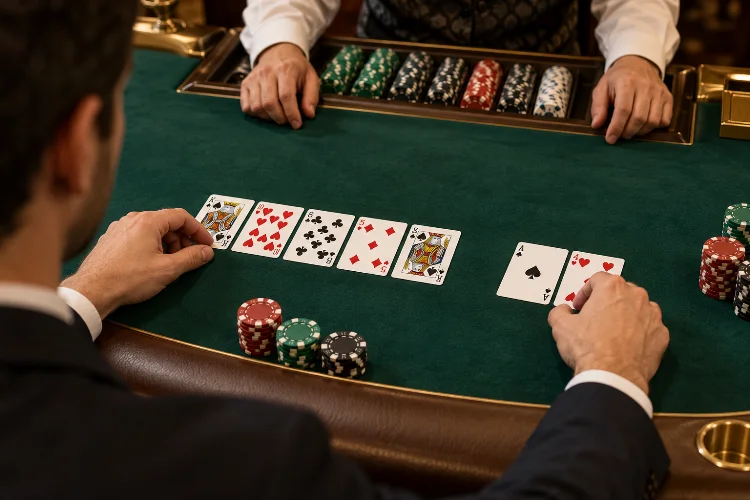

Table Games

Pai Gow Poker Rules and Basic Gameplay: How Each Round Works

Pai Gow Poker feels unusual because winning is not just about making the strongest five-card poker hand possible. You also need to reserve enough strength for a second, two-card hand. Make one side too strong and the other can become easy for the banker to beat.

Understanding Pai Gow Poker Rules and Basic Gameplay is therefore mostly about balance. The cards themselves use familiar poker concepts, but the split-hand structure changes how you think about them.

This guide walks through a typical round and explains the rules beginners are most likely to encounter at a traditional casino table.

Step 1: Seven Cards Are Dealt

Pai Gow Poker traditionally uses one standard 52-card deck plus a joker, creating a 53-card pack.

After wagers are placed, seven cards are dealt to each participating hand and the banker.

At this point, you are not drawing additional cards as you would in some poker games.

Your entire job is to arrange the seven cards you already have.

Every card must belong to one of two hands:

a five-card high hand and a two-card low hand.

The casino may use different terms such as back and front, bottom and top, or high and low. Despite the terminology, the same basic idea applies.

Step 2: Build the Five-Card and Two-Card Hands

The five-card hand uses normal poker rankings.

The two-card hand can only form a pair or a high-card combination.

There is one important restriction: the five-card hand cannot be weaker than the two-card hand.

This creates the central decision in Pai Gow Poker.

Imagine receiving:

A♠, A♦, K♣, J♥, 9♣, 6♦, 3♠.

The obvious five-card strength is the pair of aces. You might therefore keep the aces in the five-card hand and put K-J in the two-card hand.

That creates a reasonably strong front while preserving your pair behind.

The best arrangement is not always obvious, especially when you receive two pairs, three of a kind, or several possible straights.

Step 3: Understand What the Joker Can Do

The joker causes plenty of beginner confusion.

In conventional Nevada-style Pai Gow Poker, it is semi-wild, not completely wild.

It can normally function as an ace. Alternatively, it can complete a straight, flush, straight flush, or royal flush.

For example, suppose you hold 6-7-8-9 plus the joker.

The joker can represent the ten needed to finish the straight.

But if you hold K-K-8-5 plus the joker, you cannot simply declare the joker another king under the standard semi-wild rule. It would generally function as an ace instead.

There are exceptions because some California games and special variants use a fully wild joker.

Check the table before applying a rule learned elsewhere.

Step 4: The Dealer Uses the House Way

Players decide how to arrange their cards, but the dealer generally follows a fixed method known as the house way.

This is basically an internal strategy chart.

With no pair, a common house-way approach places the second- and third-highest cards in the two-card hand. With one pair, the pair commonly stays behind while the highest two remaining cards move to the front.

More difficult situations involve two pairs.

Should two pairs remain together to create a strong five-card hand? Or should one pair move forward, creating strength on both sides?

House-way charts answer these questions using rules based on pair strength and available kickers.

The precise chart is not identical everywhere, which is another reason “the house way” should not be treated as one universal strategy.

Step 5: Both Hands Are Compared Separately

Once everybody has set their cards, the dealer reveals and arranges the banker’s hand.

Then two comparisons happen.

Your two-card hand goes against the banker’s two-card hand. Your five-card hand goes against the corresponding five-card hand.

Suppose you have:

Two-card hand: K-Q
Five-card hand: 8-8-8-6-3

The banker has:

Two-card hand: A-10
Five-card hand: J-J-9-7-4

Your three of a kind beats the banker’s pair, so you win the five-card comparison.

However, A-10 beats K-Q in the two-card comparison.

The result is therefore a push: you win one side and the banker wins the other.

No profit, but no main-wager loss either.

Step 6: You Need Both Hands to Win the Wager

To win the standard main bet, both of your hands normally need to defeat the banker’s corresponding hands.

Winning only one is not enough.

This creates an interesting strategic problem.

Making an extremely strong five-card hand can sometimes be less useful if doing so leaves your two-card hand almost certain to lose.

For instance, keeping two pairs together behind might create a strong high hand. Splitting those pairs could sometimes produce a pair in each hand, potentially giving you a better chance of winning both comparisons.

That does not mean pairs should always be split.

Hand-setting decisions depend on the exact cards and rules being used.

Beginners who are uncertain can often ask how the casino’s house way would arrange the cards. That is a useful learning tool, although it is not necessarily mathematically optimal in every situation.

Step 7: Remember That Copies Favor the Banker

One of the most distinctive rules is what happens when identical-value hands meet.

The banker generally wins an exact tie, known as a copy.

Imagine both two-card hands are K-J.

That comparison belongs to the banker.

If your five-card hand beats the banker’s, the overall main wager generally pushes. If your five-card hand also ties or loses, you lose the wager.

This tie advantage is one reason the distinction between dealer and banker matters.

The dealer is the person physically operating the game. The banker is the side whose position receives the copy advantage and stands against the other wagers.

Often the house banks, but traditional rules can also allow players to bank.

Traditional Wins Usually Carry a Commission

Conventional Pai Gow Poker usually pays a winning main bet at even money less a 5% commission.

So if you wager $20 and win, the gross win would be $20, with $1 representing a 5% commission, leaving $19 in profit.

Bellagio’s published gaming guide confirms the traditional 5% structure.

However, plenty of modern tables are marketed as commission-free.

That does not mean the house has simply removed its advantage.

Commission-free variants usually introduce another special condition. In one documented version, for example, dealer nine-high in the low hand causes an automatic push. EZ Pai Gow uses another push condition based around a dealer queen-high hand.

Read the modification before assuming “no commission” means the standard game with a free upgrade.

Why Pai Gow Produces So Many Pushes

Pai Gow Poker has a reputation for producing a lot of pushes because players are effectively competing twice in each round.

It is easy to create situations where one side wins the five-card battle while the other wins the two-card comparison.

This gives the game a different rhythm from blackjack or baccarat.

Your bankroll may move more slowly simply because some rounds finish with neither a win nor a loss on the main wager.

That does not mean pushes are automatically favourable.

The house still has structural advantages, including banker treatment of exact ties under conventional rules and commission or alternative rules depending on the version.

The slower pace is an experiance characteristic, not proof that the game has no mathematical cost.

Side Bets Are Separate From the Main Game

Many modern Pai Gow tables include optional side wagers.

Fortune Pai Gow is one example. Instead of comparing your two arranged hands against the banker, the Fortune side bet evaluates the strength of your seven-card collection according to its own paytable. Caesars describes payouts tied to qualifying hands and an optional Envy feature.

These side wagers are separate from the basic game.

You can potentially lose the main wager while winning a side bet, or win the standard game while losing the optional wager.

Beginners are usually better served by learning the main two-hand comparison first.

Adding side bets before understanding the core rules can make a fairly straightforward game appear much more complicated than it is.

Pai Gow Poker Rules and Basic Gameplay become much easier once you think of the game as two poker contests happening at the same time.

Build a legal five-card hand, balance it with your two-card hand, and try to beat the banker in both comparisons.

Before wagering, check the joker rules, house way, commission, banking procedure, and any special push conditions so you know exactly which Pai Gow version you are playing.

Live Casino

Private Live Casino Tables: Inside the VIP Live Dealer Experience

Imagine opening a live casino table and finding no crowd of other players waiting to make decisions. Instead, one dealer is focused on your session, the studio is designed like a premium casino room, and certain aspects of the experience can be adjusted through chat.

That is the idea behind some Private Live Casino Tables. However, the term is used loosely across the industry. Some tables are genuinely reserved for one player, while others are simply premium or operator-specific environments.

Understanding those differences helps explain what players are actually getting from the VIP label.

Private, VIP, and Dedicated Do Not Mean the Same Thing

Live casino terminology can be confusing because operators often use premium-sounding labels differently.

A VIP table typically offers a more exclusive experience, perhaps through higher betting ranges, longer decision times, premium studios, or smaller player numbers.

A dedicated table usually refers to a table created specifically for one casino operator.

Evolution, for example, lets operators build dedicated branded tables or entire studio environments with customised interiors, betting limits, dealer teams, languages, and operating hours.

A private table can be more exclusive still.

Pragmatic Play’s Privé Lounge Blackjack and Baccarat allow only one player at the table at a time.

So when a casino advertises a “private” experience, look at the actual participation rules before assuming nobody else can join.

The Dealer Is Still Working From a Live Studio

The private experience happens online, but much of the game may be taking place in a real studio.

Professional dealers operate physical tables while multiple camera angles stream the action. Software connects the video with betting controls, balance information, game history, and other digital features.

The studio itself can be highly customised.

Playtech says its live casino network includes purpose-built studio spaces across markets including Europe, Latin America, and the United States. Its dedicated projects can combine traditional table games with branded environments and custom concepts.

For the player, the result feels like joining a casino table through a video call combined with an interactive betting interface.

The technology is complicated behind the scenes, but the front-end experience is intentionally simple.

Why Single-Player Tables Feel Different

At a standard live blackjack table, several players may be making decisions during the same round.

That naturally creates pauses.

At a genuinely single-player table, the session can revolve around one player’s interaction with the dealer.

Pragmatic Play’s Privé Lounge takes this approach. Players can request a dealer change, ask for a reshuffle or shoe change in supported card games, and extend a dealer session for up to 90 minutes.

The provider’s Privé Baccarat also lets the player influence session pacing through its “Deal Now” functionality.

These features create the feeling of having a casino table reserved specifically for you.

However, they do not mean players control the outcome.

Cards, wheels, payouts, and game procedures still follow predetermined rules.

VIP Tables May Offer a Middle Ground

Not every premium player needs an entirely private table.

Some products create exclusivity by limiting the number of participants instead.

Pragmatic Play’s VIP Blackjack tables, for example, are limited to three unique players. The provider also gives those tables longer decision and betting windows compared with its normal configuration.

This produces a more intimate environment without dedicating the whole table to one person.

That may also explain why “VIP table” and “private table” should not be used interchangeably.

If privacy is important, check the maximum number of players rather than the product name.

A luxury-looking table filled with several other participants is still fundamentally a shared game.

Personalisation Goes Beyond the Table Design

One of the biggest selling points of premium live casino environments is customisation.

The obvious elements are visual: branded backgrounds, different furniture, dealer uniforms, lighting, or custom table layouts.

But some provider systems go much further.

Evolution’s dedicated environments can integrate with CRM and loyalty systems, use native-language dealer teams, support personalised interactions, and even offer invitation-only VIP sessions.

This allows a casino to design the experience around a particular customer group or geographic market.

Playtech has also created bespoke studios for individual operators. Its Club Aurora project with evoke includes branded Blackjack and Roulette tables and forms part of dedicated environments for brands including William Hill and 888casino.

So the exclusivity may involve the whole digital environment, not simply an empty chair beside you.

How Fairness Is Maintained Behind the Scenes

Luxury décor does not replace technical controls.

In regulated environments, live games still need procedures designed to protect game integrity.

UK Gambling Commission standards state that live-dealer operations must be fair and independently auditable. Dealers should receive adequate training, relevant equipment should be monitored, gaming areas should use sufficient video surveillance, and game logs should be maintained.

The same framework also expects secure access around equipment and relevant operational areas.

This matters because a private table can feel informal and personal when the dealer is speaking directly to one customer.

Behind that interaction, however, the game should still operate through documented procedures.

The player is getting more attention – not an informal set of rules.

Does Privacy Change RTP or House Edge?

Usually, privacy itself changes nothing about the mathematics.

A baccarat table does not suddenly become player-favourable because there is only one person sitting at it.

The house edge depends on the game’s specific rules and payouts.

A different blackjack ruleset, roulette configuration, commission structure, or side bet can change mathematical expectations, but those changes need to be evaluated seperately.

UKGC standards require applicable operators to make game rules and information about participation available before customers gamble.

That is where players should look.

Instead of asking whether the table is private, ask whether its rules differ from the standard version.

The luxurious environment affects the experience. The rulebook affects the mathematics.

Betting Limits Can Be Part of the VIP Design

Premium tables are frequently associated with larger wagering ranges.

Dedicated live solutions can be configured with flexible betting limits, while operators may also tailor particular rooms to VIP customers. Evolution explicitly lists flexible limits as one option in dedicated environments.

But higher maximums are not automatically an advantage.

A larger betting range simply gives customers the ability to risk more money per round.

Players should still set limits according to their own entertainment budget.

Regulated product-design standards in Great Britain state that applicable gambling products must not actively encourage customers to chase losses or increase the amount they have chosen to gamble.

Premium treatment should therefore not be confused with a reason to abandon normal bankroll discipline.

Privacy Does Not Mean Complete Anonymity

The word “private” can also create another misunderstanding.

It usually refers to who shares the gaming table, not whether the player is anonymous to the casino.

Customers still use registered casino accounts. Depending on the jurisdiction and operator, identity verification and account monitoring requirements may continue to apply.

Live casino systems may also record game activity.

UKGC live-dealer guidance specifically requires game logs and video surveillance sufficient to review dealer procedures in regulated operations.

So a player may have a table without other customers while still participating within the operator’s normal account, security, and compliance systems.

Private means exclusive gameplay, not invisible gameplay.

Are Private Tables Worth Using?

That depends entirely on what a player values.

Someone who dislikes waiting for other blackjack players may enjoy a single-player environment. Others may appreciate direct dealer interaction, premium studio presentation, or longer decision periods.

Another person may see little reason to choose a VIP table if the standard version offers the same core game at suitable limits.

There is no automatic mathematical advantage.

The value is mainly experiential: convenience, exclusivity, atmosphere, and personlisation.

For that reason, players should compare game rules and limits first, then decide whether the premium presentation adds anything meaningful for them.

Private Live Casino Tables can range from single-player dealer sessions to invitation-only premium environments, while dedicated tables may simply belong to one casino brand. The details matter more than the label.

Check how many players can join, what rules and betting limits apply, and whether any special features genuinely improve your experience. Privacy can make live gaming more personal, but it does not turn casino odds into guaranteed value.

Casino Guides

Red Flags to Watch for When Choosing an Online Casino Before You Deposit

A polished website can make almost any online casino look trustworthy. Professional graphics, hundreds of games, big bonuses, and instant-deposit buttons tell you very little about what happens when you actually need customer service or want your money back.

That is why the Red Flags to Watch for When Choosing an Online Casino often appear in the boring details rather than the homepage design.

Licensing records, withdrawal policies, identity checks, complaint procedures, and responsible-gambling tools offer much stronger clues. Knowing what to examine before registering can make it easier to separate transparent operators from questionable ones.

A Licence Logo Means Less Than a Licence Record

One of the easiest mistakes is treating a regulator logo as automatic proof of legitimacy.

Logos can be copied.

What matters is whether the legal operator, domain, and licence status can be independently confirmed through an official regulatory database.

The UK Gambling Commission’s public register includes details such as company names, trading names, domain information, and licence status. The MGA’s register can similarly be searched using operator or URL details.

If the casino claims to be licensed but the regulator cannot find the company, do not simply assume the database is wrong.

Check the spelling, company name, and domain carefully.

A mismatched licence is one of the clearest warning signs available.

“Too Good to Be True” Bonuses Need Extra Reading

Promotions are designed to catch attention, so impressive numbers are normal.

The issue is what comes after the headline.

Imagine two casinos advertising a $500 bonus. Casino A clearly explains that wagering requirements, eligible games, and deadlines apply. Casino B gives almost no details until after registration.

Casino B deserves considerably more caution.

For British-regulated operators, promotion rules require significant conditions to be communicated clearly and transparantly. From December 19, 2025, UKGC rules also restrict bonus wagering requirements to a maximum of 10 times the bonus amount under the applicable regime.

Rules differ internationally, but the broader principle is useful everywhere: understand what the bonus actually requires before accepting it.

If the mathematics behind the promotion is almost impossible to work out, skipping it may be the better option.

Withdrawal Friction Is More Important Than Deposit Speed

A casino can process deposits in seconds and still provide a poor withdrawal experience.

Before depositing, read how withdrawals work.

Check processing times, minimum amounts, supported payment methods, fees, identification requirements, and any conditions attached to bonus funds.

A legitimate operator may perform compliance checks. That alone is not suspicious.

The red flag is inconsistent or unnecessary friction.

For example, Great Britain’s regulator says customers should not suddenly be asked for identity information at withdrawal if the operator could reasonably have requested it earlier.

Its guidance also states that deposit-balance funds should not be trapped behind unreasonable maximum withdrawal limits.

If reviews repeatedly mention cancelled payouts, endless document requests, or unexplained account freezes, investigate before depositing.

Vague KYC Policies Can Create Problems Later

Some players dislike identity verification, but having no clear KYC policy is not necessarily a positive sign.

Regulated gambling companies often need identity information for age verification, anti-fraud controls, and legal compliance.

What you want is clarity.

A casino should explain what information might be required and when.

Under UKGC rules, remote operators must verify information including name, address, and date of birth before allowing a customer to gamble. Customers should also be informed before depositing about documents or additional information they may later need to provide.

A suspicious pattern is letting someone deposit repeatedly with almost no checks and then demanding an unpredictable stream of documents only after a large win.

Clear requirements upfront are generally better than surprises afterward.

Missing Player Controls Are a Serious Warning

Take a look around the account settings before deciding whether a casino feels trustworthy.

Can you set financial limits? Is self-exclusion available? Can you find transaction history? Are time-out tools or safer-gambling information easy to locate?

Current British standards provide one useful benchmark.

Online operators must provide easily accessible financial-limit facilities, and newer requirements that took effect on September 30, 2026 specify gross deposit-limit options across defined time periods.

Regulatory requirements differ between jurisdictions, so the exact tools will vary.

Still, a casino that provides dozens of ways to deposit but makes it difficult to control spending deserves scepticism.

Player-protection features should not feel intentionally hidden.

Weak Support Often Predicts Bigger Problems

Customer support becomes much more important when money is involved.

Before registering, contact the casino with a real question.

You might ask how long withdrawals normally take or whether a specific document is needed for verification.

Look at the quality of the answer.

If one agent says three days and another says three weeks, something is wrong with either the information or the process.

A support department that cannot explain its own payment rules is unlikely to become more useful during an actual dispute.

Also check whether email addresses, company details, and complaint information are easy to find.

An operator should not become mysteriously unreachable as soon as live chat fails.

No Independent Dispute Route Is Worth Noticing

Most players hope never to file a complaint, but the process still matters.

A credible casino should explain how a formal complaint can be submitted.

In some regulated markets, unresolved complaints can then be escalated outside the company.

For example, UKGC-licensed operators must maintain complaint procedures and arrangements for eligible disputes to reach an approved ADR provider when they remain unresolved under the relevant rules.

If the casino has no written complaint process at all, that should raise questions.

Be especially careful if the terms say the operator’s decision is always final while offering no realistic appeal process.

You want to know who reviews a dispute before one actually exists.

Reviews Matter, but Patterns Matter More

Online reviews are useful, but individual comments are not perfect evidence.

One angry review may result from a misunderstanding. One glowing review may also tell you very little.

Look for repeated patterns instead.

If dozens of unrelated users describe the same withdrawal delay, unexpected bonus restriction, or closed account problem, the pattern deserves attention.

At the same time, compare review claims against regulatory records and written terms.

Do not rely purely on star ratings. Reviews can be outdated, exaggerated, incentivised, or simply wrong.

The strongest assessment combines independant licensing checks, clear policies, multiple user experiences, and your own reading of the terms.

Pressure Tactics Should Make You Slower, Not Faster

Be cautious when marketing creates unnecessary urgency.

Messages such as “deposit immediately,” repeated bonus pop-ups, or constant prompts to increase spending should not override basic research.

A casino is not going to become safer because a countdown timer is running.

Before depositing, take time to verify the company and read the conditions.

Consumer protection is built around informed choices, and regulators increasingly emphasise transparency around terms and financial controls.

If an operator seems determined to stop you from thinking, slowing down is usually the sensible response.

No promotion is worth ignoring basic due diligence.

The Red Flags to Watch for When Choosing an Online Casino usually appear in licensing records, payout rules, KYC policies, support quality, and consumer protections rather than flashy design.

Before depositing, verify the licence independently, read withdrawal and bonus conditions, and test the support team.

If important information is missing or contradictory, consider choosing another platform instead of hoping the problems will disappear.

Casino Strategy

How Variance Affects Short-Term Casino Results in Real Play

A casino game can feel strangely unpredictable. Ten rounds might disappear without a meaningful win, while another short session could produce several payouts almost immediately.

It is tempting to search for a hidden pattern, but randomness usually offers a simpler explanation.

Learning How Variance Affects Short-Term Casino Results shows why short sessions frequently look nothing like the long-term percentages advertised for a game.

Variance affects the size of possible swings, while randomness determines the order in which individual outcomes appear. Together, they explain much of what players experience during real-world play.

Variance Measures the Spread of Possible Outcomes

Every casino game has a range of possible results.

Some wagers may return nothing. Others return the original stake plus a modest prize, while certain games include outcomes worth many times the initial wager.

Variance provides a statstical way to describe how spread out those results are around the expected average.

When most results remain relatively close together, variance is lower. When the game mixes many losing outcomes with occasional very large payouts, variance becomes higher.

This is why two games with similar theoretical RTP percentages can feel completely different during a 30-minute session.

RTP describes the destination over a large sample. Variance says much more about how bumpy the road might become.

Random Outcomes Do Not Arrive in a Smooth Pattern

Human intuition often expects randomness to look balanced.

We imagine wins and losses appearing in a neat alternating pattern. Genuine randomness does not work that way.

Six losses in succession can occur. So can several wins within a short period. Clusters are not automatically evidence that a machine has become “cold” or “hot.”

The UK Gambling Commission requires relevant remote gaming systems to produce outcomes that are acceptably random and unpredictable. Its standards specifically state that RNG output should follow expected theoretical probabilities while remaining unpredictable.

That unpredictability creates the irregular patterns players see in short sessions.

A Simple Example Shows Why Short-Term Results Vary

Consider a hypothetical game where a player repeatedly wagers $10.

Imagine that after 20 rounds the total amount wagered is $200. One player might receive $240 back and finish $40 ahead. Another could receive only $130 and finish $70 behind.

Those outcomes do not automatically mean the underlying game has different mathematics for different players.

Twenty rounds are simply a tiny sample.

The same principle applies to RTP monitoring. The UK Gambling Commission explains that RTP is an average measured across a large number of games and that actual session results can vary because of normal game volatility.

A short-term result is therefore a snapshot, not a reliable measurement of long-term performance.

Why High-Volatility Games Feel More Dramatic

High-volatility games concentrate more value into less frequent outcomes.

Imagine two theoretical games with comparable RTP.

Game A pays smaller amounts relatively frequently. Game B produces many more unrewarding rounds but includes a chance of much larger prizes.

Even when their long-term expected returns are close, the second structure creates wider bankroll swings. Players can go through longer dry periods, followed by sudden jumps when an uncommon outcome appears.

Gaming Laboratories International evaluates both RTP and volatility when analysing casino game mathematics. The distinction is important because identical or comparable return percentages do not imply identical payout distributions.

For players comparing games, RTP alone therefore gives an incomplete comparision.

Bet Size Magnifies the Effect of Variance

Variance exists regardless of stake size, but larger wagers make its financial impact more noticeable.

Suppose two players have $300 entertainment budgets.

One places $3 wagers, while the other places $30 wagers. Both encounter the same sequence of proportional game results.

The second player experiences changes that are ten times larger in monetary terms and can exhaust the available budget much faster.

Increasing bets after a losing streak does not eliminate variance. It increases the amount of money exposed to the next uncertain result.

Keeping stakes modest relative to an entertainment budget cannot remove the house edge, but it can reduce how rapidly normal short-term fluctuations consume that budget.

Winning Streaks Do Not Change the Underlying Odds

Variance can also create winning streaks, and these can be psychologically misleading.

After several successful rounds, a player might feel the game is currently paying better. After repeated losses, another player might believe a recovery is becoming increasingly likely.

For independent events, neither conclusion is justified simply by the streak.

The Responsible Gambling Council describes the gambler’s fallacy as the mistaken belief that previous outcomes change the probability of future independent events. A slot machine, for example, does not become obligated to generate a winning result because several earlier spins lost.

Randomness can produce streaks without giving those streaks predictive power.

Short-Term RTP Can Look Completely Different

Suppose a slot lists a theoretical RTP of 96%.

A common mistake is assuming that every $100 wagered should produce roughly $96 in immediate returns. But that percentage is not a promise for an individual player or session.

Actual short-term RTP could temporarily be far higher or lower.

The UK Gambling Commission gives an example of a game designed with a 91.68% theoretical RTP that recorded an actual 90.42% over a measured period.

Its guidance emphasizes that volatility and volume of play must be considered when deciding whether observed performance is within an acceptable range.

The larger the dataset becomes, the more meaningful the long-term percentage becomes.

Variance Can Influence Player Psychology

The mathematics may be straightforward, but the emotional side is harder.

A quick win can make random success feel repeatable. A long losing period can create frustration and encourage attempts to recover money immediately.

That is where understanding variance becomes practical.

A streak does not mean someone has discovered a consistant winning method. Likewise, an unusually bad session does not make the next wager safer.

Responsible Gambling Council research materials emphasize that understanding randomness, independence of events, house advantage, and probability can help address mistaken beliefs about gambling outcomes.

Viewing casino play as paid entertainment rather than an income strategy creates a much more realistic enviroment for decision-making.

Use Variance as Context, Not a Prediction Tool

Variance is useful because it explains why results can move dramatically over short periods.

It is not useful for predicting the exact next spin, card, or roulette result.

Even a detailed understanding of standard deviation and payout distribution cannot turn an unpredictable independent event into a predictable one.

The practical lesson is simple: expect uneven results, avoid interpreting streaks as signals, set spending limits before playing, and remember that theoretical percentages become meaningful primarily across very large samples.

Understanding How Variance Affects Short-Term Casino Results explains why brief sessions can produce profits, losses, and streaks that look disconnected from published RTP figures.

Variance measures fluctuation, while long-term mathematics describes averages.

Use that knowledge to interpret results more realistically, avoid chasing supposed patterns, and keep any gambling spending within a predetermined entertainment budget.

Casino Strategy

The Gambler’s Fallacy in Everyday Decisions: Why “Due” Feels Real

You apply for three jobs and receive three rejections. Is the fourth application now more likely to succeed? A manager approves several requests in a row and starts feeling that the next one should probably be rejected.

A stock falls for several days, and an investor assumes a rebound must be coming. These examples share the same mental shortcut.

The Gambler’s Fallacy is usually introduced through coins, roulette, or lotteries, but research suggests the basic bias can reach much further.

Whenever we expect an unrelated streak to automatically reverse, our decisions can drift away from the evidence.

The Brain Likes Balanced Stories

Randomness is uncomfortable.

People naturally prefer explanations where events fit into patterns: success follows effort, losses eventually reverse, and unusual streaks correct themselves.

Real random sequences are much messier.

A fair process can create five similar outcomes in a row, then another five, without violating any statistical rule. Short samples simply do not have to look like the long-run average.

The gambler’s fallacy develops when we expect that balancing process to happen too quickly.

A person might think:

“I have failed three interviews, so I must be closer to success.”

Success may indeed become more likely if experience improved their interview skills. But if nothing relevant has changed, the previous failures themselves do not magically improve the next outcome.

The critical question is always whether a real causal mechanism exists.

Decisions Can Become Biased by What Happened Just Before

One fascinating area of research asks whether the fallacy influences professional decisions.

A major study by Daniel Chen, Tobias Moskowitz, and Kelly Shue examined asylum judges, loan officers, and Major League Baseball umpires. The researchers reported patterns of negatively correlated decisions consistent with people becoming less likely to repeat the same decision after a streak.

For example, after several similar outcomes, a decision-maker may unconsciously feel that another identical decision would create an “unbalanced” sequence.

But each new case should ideally be evaluated on its own evidence.

The study found the sequential effect was stronger in certain circumstances, including after longer runs and among less experienced decision-makers.

The authors also considered alternative explanations, so the results should not be interpreted as proof that every sequential decision is caused by this bias.

Still, the finding demonstrates how seemingly irrelevant prior events can influence judgement.

Investing Can Create the Same Reversal Story

Financial markets are full of streaks.

A stock can rise for several sessions. A market can fall for a week. Investors naturally start asking whether the movement has “gone too far.”

Sometimes there are genuine reasons to expect mean reversion. Valuation, liquidity, economic fundamentals, or market structure can matter.

The fallacy happens when someone expects a reversal only because a streak occurred.

Research using individual-level trading data has found evidence consistent with gambler’s-fallacy behavior after certain price streaks. It also found that investors could shift toward hot-hand-style continuation beliefs as streaks became longer.

More recent research has also explored gambler’s-fallacy-like expectations in housing markets.

A 2026 study using Chinese housing data reported that stronger previous price increases were associated with lower expectations of future increases, consistent with reversal beliefs in that particular population and setting.

These findings do not mean markets are random coins. They show why evidence about fundamentals should be kept seperate from intuitive beliefs that prices simply “must turn around.”

Losing Streaks Can Encourage Riskier Choices

A particularly dangerous version appears after repeated losses.

Someone might think:

“I have lost four times already. Winning has to happen soon.”

This feeling can make another wager seem safer than it really is.

Experimental research has found greater risk-seeking after losses than after wins in controlled tasks, with the pattern resembling the gambler’s fallacy. Neuroimaging work also suggests that previous outcomes can influence the brain systems involved in later risky decisions.

Another laboratory study involving roulette-style sequences found that bets increased during losing streaks. The researchers connected this effect with loss-chasing behavior.

The mathematical issue is straightforward.

A series of losses does not create credit that a random process needs to repay.

Treating the next decision as compensation for previous losses can therefore lead to greater risk at exactly the moment emotions are already running high.

Recent Research Adds an Important Nuance

Psychology rarely stays completely simple.

A 2025 paper examined whether the gambler’s fallacy appears differently when people give a precise probability estimate rather than choosing which outcome they think will happen next.

Across preregistered studies involving 750 U.S. adults, the researchers reported a gambler’s-fallacy effect in point predictions but did not find the same pattern when participants directly estimated probabilities.

That distinction is interesting.

Someone may understand intellectually that heads and tails are each 50%, yet still choose tails after several heads when forced to pick one outcome.

The researchers argued that the bias may therefore sometimes emerge at the decision stage, rather than purely from incorrect probablity beliefs.

In everyday language: knowing the odds correctly does not guarantee that your final choice will follow them.

Not Every Streak Is Random

Avoiding the gambler’s fallacy does not mean ignoring every pattern.

Some events really are dependent.

Imagine drawing cards from a deck without replacing them. Each removed card changes what remains, so earlier outcomes genuinely influence later probabilities.

Performance can also change.

If a football player becomes exhausted, an employee improves through practice, or a machine begins malfunctioning, recent outcomes may contain real information about future results.

The mistake is automatically treating independent events as if they were connected – or assuming that any streak must soon reverse.

A useful distinction is:

Random streak

The same outcome happened several times, but nothing about the process changed.

Informative streak

Repeated outcomes provide evidence that the underlying process itself may have changed.

Good judgement requires figuring out which situation you are actually facing.

Watch for “It Has to Happen Eventually”

The phrase “it has to happen eventually” contains a subtle trap.

Over a very large number of fair coin flips, both heads and tails should appear many times. But no rule guarantees tails on the next flip simply because heads has dominated recently.

Long-run frequencies and short-run predictions are different questions.

This distinction also matters outside gambling.

A salesperson might assume the next customer “must” buy because ten people said no. A recruiter may feel uncomfortable hiring several candidates with similar profiles in succession. A manager might expect a bad month after several unusually strong months.

Sometimes circumstances genuinely change. Sometimes they do not.

The streak itself is not enough evidence.

How to Make Better Decisions Around Streaks

The simplest defense is to temporarily hide the sequence.

Ask yourself: If I did not know the previous outcomes, what would I think about this choice based only on the current evidence?

That question separates relevant information from emotional history.

Next, identify whether events are independent. If they are not, determine exactly how earlier outcomes change current probabilities.

Finally, use base rates instead of stories.

If a loan applicant historically has a certain risk profile, the previous applicant’s approval should not influence the assessment. If a fair random event has fixed probabilities, recent outcomes should not overwrite those numbers.

Writing down decision criteria in advance can also reduce the temptation to invent new logic after a streak appears.

The Gambler’s Fallacy is more than a casino misconception. The same expectation of automatic reversal can influence investing, professional judgement, risk-taking, and everyday predictions whenever recent outcomes feel too repetitive.

The best defense is to separate patterns from causes. Before assuming something is “due,” ask whether previous events actually changed the current probability. If they did not, the streak may be psychologically interesting but statistically irrelevant.

Casino Games

Classic Casino Games: How Traditional Favorites Evolved for Today

A blackjack table from decades ago and a live blackjack stream on a smartphone may look completely different, but they are built around the same card values and basic objective. Roulette, baccarat, craps, poker, and slots have followed a similar path.

Instead of disappearing when casinos became more digital, Classic Casino Games adapted.

Major physical casinos still offer traditional table formats, while modern providers stream familiar games from professional studios and reproduce others through electronic terminals or RNG software.

The interesting question is not why the classics vanished, but how they successfully changed.

Traditional Casino Floors Still Matter

Digital gambling has expanded enormously, but the physical casino table has not become obsolete.

Walk through a current Las Vegas casino and the familiar names are still there. MGM Grand lists blackjack, baccarat, craps, roulette, and several poker formats, while The Venetian describes baccarat, blackjack, and roulette as part of its selection of classic casino table games.

The Cosmopolitan similarly continues to offer blackjack, roulette, craps, baccarat, and several poker-based games.

Physical tables provide something difficult to duplicate entirely on a screen: people sharing the same space.

That matters particularly for craps, poker, and dealer games where interaction contributes to the atmosphere.

The traditional casino floor therefore became one branch of a much wider ecosystem rather than being replaced outright.

Blackjack Became Faster and More Flexible Online

Classic blackjack usually uses a limited number of seats around a dealer.

Live technology removed some of those physical limitations.

Evolution’s standard live blackjack still resembles a traditional seven-seat table, but its Infinite Blackjack format allows an unlimited number of participants to receive a common starting hand before making their own decisions independently.

Other versions add faster decision systems, multipliers, or additional side wagers.

Yet the core objective remains familiar: produce a valid hand stronger than the dealer’s without busting.

That familiarity lowers the learning barrier. Someone who understands traditional blackjack can usually recognise the basic structure even when a modern version adds extra mechanics.

The new features change the experiance, not the identity of the game.

Roulette Was Almost Made for Digital Screens

Roulette already has a naturally visual format.

The wheel spins, the ball moves, and players watch one numbered pocket determine the result.

That made the game well suited to live streaming.

Evolution’s current online portfolio includes standard roulette alongside variations that introduce new features, while casino properties such as Bellagio still present the traditional physical wheel and betting layout.

Electronic table games offer another adaptation.

MGM National Harbor currently provides hybrid electronic products where players use individual terminals while participating in dealer-supported versions of games including roulette, blackjack, and baccarat.

This format changes how bets are entered but preserves the underlying result.

Whether chips are physically placed on felt or tapped onto a touchscreen layout, the player is still predicting the roulette outcome.

Baccarat Became Accessible Beyond High-Limit Rooms

Baccarat has long carried an image of formal tables and higher-stakes casino areas.

Digital formats changed that presentation considerably.

The essential game remains focused on Player, Banker, and Tie outcomes, with drawing rules determining how each hand develops.

Live baccarat now appears across numerous online tables, sometimes with lower minimums, configurable side bets, multiple camera views, and statistics displayed directly on the interface.

Evolution’s current portfolio includes standard baccarat as well as variations such as Peek Baccarat and Lightning Baccarat.

Physical casinos have evolved the game too. Beau Rivage currently promotes a no-commission baccarat variation alongside traditional versions.

Baccarat therefore shows how a classic can keep its basic rules while changing its pacing, presentation, and betting options.

Craps Expanded Into Electronic and Online Formats

Craps once seemed especially difficult to translate away from a physical casino.

The game revolves around a shooter rolling dice while a group of players follows the action around a large betting layout.

Yet the core mechanic is ultimately mathematical: dice totals determine what happens to active bets.

That made electronic adaptation possible.

MGM National Harbor currently offers electronic gaming formats linked to games such as craps, alongside regular physical tables. Evolution also includes live Craps among its digital live-casino categories.

The online interface can even make the complicated layout easier for some beginners because valid betting positions and payouts can be displayed interactively.

The atmosphere may be diferent, but the familiar come-out roll, point, and seven-out concepts still anchor the game.

Slots Moved From Mechanical Reels to Software

The transition of slot machines is perhaps the clearest example of technological evolution.

Historic machines were mechanical devices built from metal, glass, springs, reels, and coin mechanisms. The Smithsonian preserves examples from manufacturers such as Mills Novelty Company, including machines dating to the 1930s and 1950s.

Today, slots are usually electronic.

Digital technology allows developers to create animated reels, cascading symbols, expanding grids, free spins, jackpots, multipliers, and interactive bonuses that would have been impossible on a purely mechanical machine.

Yet the core action remains remarkably familiar.

A wager starts a game cycle and the final arrangement determines the result according to the game’s rules.

That continuity is one reason modern slots can look radically new while still feeling recognisably like slot machines.

Poker Adapted Without Losing the Human Element

Poker faced a different challenge.

Much of its identity comes from competition between players, making human decision-making central rather than optional.

Online poker solved the physical-space problem by replacing chips and cards with a digital interface while preserving betting rounds, hand rankings, and player decisions.

Casinos also developed more house-banked poker variants.

MGM Grand currently offers traditional poker alongside games such as Three Card Poker, Ultimate Texas Hold’em, Pai Gow Poker, and Let It Ride Poker.

Live casino technology has added another branch, bringing dealer-hosted poker-style games onto streamed platforms. Evolution’s portfolio also continues to list poker among its core live-casino categories.

So poker did not evolve in one direction. It split into poker rooms, online multiplayer games, dealer-based table variants, and live-streamed formats.

Why Classic Formats Adapt So Well

The most durable casino games have a strong central mechanic.

Blackjack revolves around 21. Roulette revolves around the wheel. Baccarat compares Player and Banker. Craps uses dice sequences. Poker uses card rankings and decisions, while slots revolve around reel outcomes.

Those foundations are easy to recognize even after developers add new technology.

Evolution’s current product range explicitly combines classic roulette, blackjack, baccarat, poker, and craps with newer digital variations and live game shows. Meanwhile, major physical casino operators continue offering many of the same traditional games on their floors.

That coexistence suggests adaptation rather than replacement.

New presentation can attract attention, but familiar rules give players something immediately understandable underneath.

Classic Casino Games survived technological change because their basic mechanics are flexible.

Cards can be dealt physically or streamed, roulette bets can be placed with chips or touchscreen controls, and slots can move from mechanical reels to sophisticated software.

If you want to understand modern casino games, learn their classic foundations first. Once the original rules make sense, electronic, live dealer, and feature-rich variations become much easier to follow.

Casino Bonuses

How Casino Loyalty Programs Work: Points, Tiers, and Real Value

Casino loyalty programs love big numbers. An account might show thousands of points, hundreds of Tier Credits, a progress bar toward another status level, and several promotional offers at the same time.

Without context, those figures can look more valuable than they actually are. This guide to How Casino Loyalty Programs work takes a more practical approach.

Instead of simply listing benefits, we will look at earning rates, redemption value, tier qualification, expiration, and personalized rewards so you can understand what a loyalty account is really offering.

Start With the Value of One Point

Seeing 10,000 loyalty points means very little until you know what each point can buy.

Some casino programs provide a relatively clear conversion.

Unity by Hard Rock currently states that 100 Unity Points generally equal $1 USD for qualifying purchases, although conversion rates may vary. That would make 10,000 points worth around $100 under the standard 100-to-$1 conversion.

Other programs use multiple reward balances.

Wynn Rewards, for example, distinguishes slot points, FREECREDIT, COMPDOLLARS, and Tier Credits. The current Wynn program says 500 eligible slot points can be converted to $5 in FREECREDIT under its published Las Vegas rules.

This is why you should never compare two programs simply by asking which one awards more “points.”

The useful comparision is what those points become after redemption.

Earning Rates Depend on What You Do

Casino loyalty earning is rarely based on one universal formula.

Gaming, rooms, dining, retail, and entertainment can all have different earning rates. Even within gaming, slots, video poker, and table games may be treated differently.

Wynn currently awards one slot point for every $5 of coin-in on participating slots, while eligible video poker can require $10 or $20 coin-in per point depending on the game. Table-game Tier Credits are instead based on factors including average bet, game type, and time played.

Unity also separates non-gaming and gaming activity. Its published information lists specific rates for qualifying non-gaming purchases while noting that casino gaming earn rates can vary by property and individual play.

The practical lesson is straightforward: earning 500 points through one activity may require very different spending or play from earning 500 somewhere else.

Tier Credits Usually Measure Status, Not Spending Power

Tier Credits often look like reward currency because their balance increases as you play or spend.

But they usually cannot simply be exchanged for dinner or hotel nights.

Their job is to determine membership status.

MGM Rewards currently requires 20,000 Tier Credits for Pearl, 75,000 for Gold, and 200,000 for Platinum, while NOIR remains invitation-only. Some higher levels come with additional benefits such as bonus SLOT DOLLARS, resort-fee waivers, celebration credits, or qualifying travel benefits.

Wynn takes a different approach, currently listing Red from 0-6,999 Tier Credits, Platinum from 7,000-69,999, and Black at 70,000 or more, alongside an invite-only Chairman’s Club.

Those thresholds demonstrate why status names alone are not useful for cross-program comparison.

What matters is the qualification requirement and what you actually receive after reaching it.

Personalized Offers Are Not the Same as Published Benefits

Two members at the same tier may not always receive identical promotional offers.

Published tier benefits are usually relatively predictable. If a program states that a certain status includes a defined parking benefit or points bonus, qualifying members can understand the rule in advance.

Promotional offers can work differently.

Casinos may send targeted hotel deals, Free Play, event invitations, dining promotions, or other incentives based on activity and internal marketing criteria. MGM’s current tier information, for example, distinguishes formal tier features from personalized offers available within the program.

That makes it useful to separate guaranteed published benefits from personalized promotions.

A promotional room offer received last month should not automatically be treated as a permanent membership entitlement.

Check Expiration Before Saving Rewards

One of the easiest ways to lose value is forgetting when points expire.

Different programs have very different policies.

Wynn says slot points must generally be redeemed for FREECREDIT within 12 months of earning, and converted FREECREDIT has another stated redemption window.

Unity says eligible activity within 180 days can keep Unity Points from expiring, while redeeming points itself does not restart that activity clock.

Tier status can follow another calendar entirely.

MGM describes an annual Tier Status Earning Year, with Tier Credits resetting at the start of a new earning period. Wynn likewise uses annual Tier Credit qualification and published benefit periods.

Before building a large balance, read the expiration and reset conditions. A reward worth $50 today can be worth nothing if it expires before the next visit.

Calculate Reward Value Before Chasing the Next Tier

Tier progress bars are designed to make the next level feel close.

Imagine you are 5,000 credits away from another status. The next level includes benefits you personally value at approximately $150.

If reaching it would require thousands of dollars of additional unplanned gambling or spending, the mathematics clearly changes.

The right question is not, “How close am I?”

It is, “Would I naturally reach this level through activity I already intended to do?”

Casino gambling also carries an underlying house advantage, meaning gambling additional money solely to generate reward value can create expected losses larger than the loyalty benfit.

Rewards are most useful when they reduce the cost of an activity you were already planning.

Promotions and Loyalty Rewards Can Have Extra Conditions

Bonus money, Free Play, multipliers, and promotional credits may come with terms that normal redeemable points do not.

Always check eligible games, expiration dates, maximum redemption, wagering conditions, and whether the reward can be converted to withdrawable cash.

Regulation varies by jurisdiction. In Great Britain, updated Gambling Commission rules effective in 2026 require bonus and reward terms to be clear, transparent, fair, and accessible.

Promotional wagering requirements are capped at 10 times, and an individual incentive cannot combine multiple gambling product categories such as casino and betting.

The Commission also advises consumers to check restrictions carefully, including rules governing bonus funds and permitted bet sizes.

Those rules do not apply globally, but they illustrate why reading the conditions matters.

Do Credit Cards and Resort Spending Change the Equation?

Some casino ecosystems now allow members to earn through activities beyond gambling.

Hotel rooms, dining, entertainment, merchandise, and branded credit cards can all contribute in certain programs.

Unity is built around this broader model, allowing qualifying earning across participating Hard Rock hotels, Cafes, casinos, and Rock Shops.

MGM also awards Rewards Points or Tier Credits through eligible resort spending and certain linked products under its current program structure.

For someone already taking a resort vacation, these non-gaming routes can provide additional value without increasing casino play.

Just remember that credit-card rewards should never justify carrying interest-bearing debt. A few loyalty dollars can disappear quickly if interest charges exceed the redemtion value.

A Simple Way to Compare Loyalty Programs

Before deciding whether a casino rewards program is useful, look at four numbers: earning requirement, point value, expiration period, and the realistic value of the next tier.

Then consider where the rewards can actually be used.

A program offering hotel, dining, and entertainment redemption may be more useful to a frequent resort visitor. Someone interested only in casino Free Play may value the same program differently.

Also consider geography.

A fantastic rewards network has limited value if none of its participating properties are places you regularly visit.

The strongest loyalty program is therefore not necessarily the one with the highest tier names or biggest promotional numbers. It is the one whose rewards naturally fit your existing activity without encouraging extra spending.

Learning How Casino Loyalty Programs calculate points and status makes their value much easier to judge.

Focus on the real redemption rate, earning requirements, expiration rules, published tier benefits, and promotional conditions rather than impressive-looking balances.

Before chasing a higher level, calculate what the perks are actually worth to you. The most valuable rewards are usually the ones earned from trips, meals, stays, or entertainment you already planned.

Live Casino

Live Casino Game Shows Explained: Wheels, Bonuses, and Multipliers

Traditional casino games usually revolve around familiar formats: cards, roulette wheels, or dice. Live casino game shows take those ingredients and mix them with bright studios, presenters, animated bonuses, giant multipliers, and game-show-style suspense.

In this Live Casino Game Shows Explained guide, we will look beyond the colourful presentation and focus on the mechanics underneath.

You will learn how money wheels work, why bonus segments are less frequent than ordinary outcomes, how digital features interact with physical equipment, and what payout percentages and volatility actually mean when choosing between different games.

Start by Reading the Betting Screen

The easiest way to understand a live game show is to ignore the decorations for a moment and look at the betting interface.

Each available position represents a prediction. In a wheel game, those predictions might include numbers, colours, bonus symbols, or special events.

During the betting window, players can usually see the available positions and their basic payouts. When the countdown reaches zero, wagering closes and the result is generated.

A title such as Crazy Time uses eight main betting options: four number positions and four bonus-game positions.

That means you do not need to understand the entire studio immediately. Start by asking one question: What exactly does each betting position need to happen in order to win?

How Money Wheels Create Different Probabilities

A money wheel may look like a collection of equally important symbols, but frequency depends on how many physical segments each symbol occupies.

MONOPOLY Live has a 54-segment wheel. Most segments contain regular numbers, while bonus options such as 2 ROLLS and 4 ROLLS appear less frequently.

Crazy Time also uses a 54-segment main wheel containing number positions and four different bonus symbols.

This creates a simple probability relationship.

If one outcome occupies many sections of the wheel, it has more potential stopping positions. A rare bonus segment may offer a much more elaborate feature, but it also occupies fewer spaces.

That is why the largest-looking payout is not automatically the most likely event.

Bonus Games Add a Second Layer of Randomness

Many modern game shows are essentially games inside another game.

First, the main wheel must land on the correct bonus segment. Then the bonus itself determines a multiplier or additional result.

Crazy Time illustrates this clearly.

Cash Hunt hides multipliers behind selectable symbols. Pachinko sends a puck through a peg board toward multiplier landing zones. Coin Flip assigns multipliers to two sides before the coin result is revealed. The Crazy Time bonus uses another large virtual wheel.

So landing the bonus does not tell you the final payout.

It only moves the round into another stage.

This two-step structure explains why bonus rounds can feel much more unpredictible than ordinary numbered positions.

Multipliers Can Work in Several Different Ways

A multiplier simply increases a payout, but the way it becomes active varies from game to game.

In Crazy Time, the Top Slot can select betting positions and attach enhanced multipliers to them before the main wheel result is known.

Sweet Bonanza CandyLand uses another system. Its Sugar Bomb mechanic can trigger a random multiplier and an extra wheel spin, while certain booster rules can increase the effect further.

Lightning Roulette applies the idea to a familiar casino game. Evolution’s version selects between one and five Lucky Numbers and attaches random Lucky Payouts ranging from 50x to 500x.

The term “multiplier” therefore tells you very little by itself.

Always check what activates it, which wager it applies to, and whether the standard payout changes when the multiplier system is active.

Physical Results and RNG Can Exist Together

The word “live” sometimes creates the impression that every part of the game is controlled only by physical equipment.

Modern game shows are often more complex.

A physical wheel may determine the main outcome while a Random Number Generator handles extra features such as multipliers or bonus selections.

Lightning Roulette is a good example. The roulette result comes from the physical wheel, while RNG technology generates the Lucky Numbers and their additional payouts.

Evolution also offers First Person versions of certain games. These use RNG-based gameplay but are designed to resemble live studio products, with some versions offering a transition to the hosted live experience.

Knowing this distinction helps beginners understand why a game can contain both physical and digital randomness at the same time.

Different Game Shows Can Feel Completely Different

Not every live game show is built around the same mechanic.

Dream Catcher helped establish the large-wheel format, while MONOPOLY Live combines a wheel with a digital board-game bonus. Crazy Time adds several seperate bonus games to one wheel. Sweet Bonanza CandyLand mixes wheel gameplay with slot-inspired features and virtual bonuses.

The category has also continued expanding.

Evolution’s current portfolio includes game shows based on wheels, numbered-ball draws, racing-style concepts, and other interactive formats. Its 2025 portfolio expansion included products such as Ice Fishing, Red Baron, Race Track, Super Color Game, and Marble Race.

For beginners, this means learning one game does not automatically teach you all of them.

The common structure is live presentation plus wagering, but the actual rules can vary dramatically.

What RTP Means in a Game Show

RTP stands for Return to Player.

It represents the theoretical proportion of stakes returned as prizes over a very large number of rounds. It is not a promise about what will happen during one evening or even hundreds of spins.

The UK Gambling Commission explains that actual results can move above or below theoretical RTP over shorter periods, particularly when a game has higher volatility. As more rounds are played, long-term results should move closer to the theoretical figure.

Some game shows also have different RTP values depending on the betting position.

Crazy Time, for instance, lists theoretical RTP figures ranging from approximately 94.41% to 96.08%, depending on the selected wager.

That is a useful reminder that you cannot always describe an entire game with a single payout percentage.

Do Recent Results Help Predict the Next Round?

Live game-show interfaces often display previous results.

You may see recent wheel positions, bonus appearances, multiplier histories, or other statistics. They can make the game more interesting to follow, but they do not provide a reliable forecast.

Evolution states directly that Crazy Time spins are independent and that previous outcomes cannot be used to predict the next result.

For example, imagine the Crazy Time bonus has not appeared for many rounds. That absence does not mean it must appear soon.

This is sometimes called the gambler’s fallacy: assuming past independent outcomes force future results to “balance out.”

Understanding that idea is more usefull than trying to memorise long streaks on the history panel.

A Beginner-Friendly Way to Explore a Game

Before placing any wager, spend a few rounds simply watching.

Identify the betting timer, main outcome generator, bonus positions, and payout display. Then open the game’s help or information screen and check how the bonus rounds and multipliers work.

Also pay attention to whether a bet enters the bonus automatically or only qualifies when you specifically selected that bonus position.

Crazy Time, for example, allows everyone to watch its bonus rounds, but only players who placed a corresponding bonus wager participate in the payout.

That single rule can prevent a lot of beginer confusion.

Once you understand the sequence, the bright lights and animations become much easier to interpret.

Live Casino Game Shows Explained is less complicated once you break each title into three parts: the main betting event, any multiplier system, and the bonus mechanics that follow.

Different games combine physical wheels, RNG features, virtual worlds, and live presenters in different ways.

Before playing, check the payout information and watch several rounds so you understand exactly what each betting position actually does.

Table Games

Craps for Beginners: Table Layout, Bets and Dice Rules Made Simple

Walk past a craps table and you may hear cheering one moment and groaning a few seconds later. Meanwhile, chips cover different boxes and the dealers seem to understand a language made entirely of numbers.

Fortunately, the game underneath all that activity is fairly logical. This Craps for Beginners guide approaches the table like a map.

Instead of memorizing dozens of bets, you will learn which sections matter first, what the dice are trying to accomplish, and how probability influences some of the most common wagers.

Read the Craps Table From the Outside In

A traditional layout looks complicated because it needs space for many wagers and several players.

The easiest place to begin is around the outside edge. This is where you will normally find the Pass Line and Don’t Pass areas.

Move inward and you will see the COME box, number sections for 4, 5, 6, 8, 9, and 10, the FIELD, and then a busier central zone containing proposition and hardway bets.

You do not need to understand every section at once.

Think of the layout as layers. Learn the outside layer first, then the numbered boxes, and leave the center until the basic flow feels comfortable.

Learn the Two Stages of a Craps Round

Most of the basic game revolves around two stages.

The first is the come-out roll. On a Pass Line wager, 7 or 11 wins immediately, while 2, 3, or 12 loses. A roll of 4, 5, 6, 8, 9, or 10 establishes the point.

The second stage begins after that point is set.

Suppose 5 becomes the point. The shooter continues rolling until either 5 appears again or a 7 appears. A repeated 5 completes the point; a 7 ends the sequence.

Other totals can appear in between without resolving the basic Pass Line bet.

Once this pattern becomes automatic, the table starts looking much less chaotc.

Pass Line and Don’t Pass Take Opposite Views

The Pass Line is built around the shooter successfully making the point.

The Don’t Pass wager mostly takes the opposite position. On the initial roll, 2 or 3 wins the Don’t Pass wager, 7 or 11 loses, and 12 is generally treated as a push under common Las Vegas rules. After a point is established, Don’t Pass wins when 7 appears before the point.

Mathematically, these two basic wagers are relatively close.

Wizard of Odds lists the standard Pass Line house edge at approximately 1.414% and Don’t Pass at approximately 1.364%.

That difference is small, but it illustrates an important idea: two boxes sitting next to each other can have slightly different mathematics even when their payouts look similar.

Why 6 and 8 Look So Important

Look at the number boxes and you will probably notice plenty of action around 6 and 8.

There is a mathematical reason.

With two fair six-sided dice, 6 can be made in five combinations. The same is true for 8. Numbers 5 and 9 have four combinations each, while 4 and 10 have three each.

Only 7 has more combinations, with six.

This means 6 and 8 occur more frequently than the other standard point numbers, although 7 is still more likely than either one individually.

Place bets use these number boxes. A Place 6, for example, wins if 6 appears before 7 and usually pays 7:6 under standard rules.

Knowing the dice combinations helps explain the payout structure instead of making it look arbitrary.

What Taking Odds Actually Means

The word “odds” has a special meaning on a craps table.

After establishing a point through a Pass Line or Come bet, a player can generally place an additional odds wager behind the original bet.

The payout changes with the point because each number has a different probability of appearing before 7. Standard payouts are 2:1 for 4 or 10, 3:2 for 5 or 9, and 6:5 for 6 or 8.

Those payments correspond to the actual mathematical odds, so the odds portion carries no house edge.

There is an important catch for new players: zero house edge does not mean zero risk.

You are still putting more money into action, and the point can still lose. Treating a mathematically fair wager as guaranteed profit is a common misunderstandng of what “true odds” means.

Come Bets Create Another Point

The COME area sits prominently in the middle of the layout because it allows players to start another point-like wager while the main round is already underway.

Suppose the table point is 8 and you place a Come bet.

If the next roll is 6, then 6 becomes your personal Come point. Your chips move to that number. From there, the wager wins if another 6 appears before a 7.

Meanwhile, the table’s original point remains 8.

This means several numbers can have active wagers at the same time. It also explains why watching an experienced craps table can seem confusing: different chips may be waiting for different outcomes from the same dice roll.

Field, Hardways, and Proposition Bets

Now we reach the louder-looking parts of the layout.

The Field is generally a one-roll wager covering several totals. At The Venetian, for example, its published rules show wins on 3, 4, 9, 10, and 11, with larger payouts for 2 and 12, while 5, 6, 7, and 8 lose.

Hardways are based on rolling matching dice before either a 7 or the same total “the easy way.” A hard 8, for example, requires 4+4 rather than combinations such as 5+3.

Proposition bets focus on specific outcomes such as a particular total on the next roll.

These areas can offer larger advertised payouts, but larger payouts do not automatically mean better mathematical value.

The UK Gambling Commission describes house edge as the average advantage built into casino games and requires licensed British casinos to make game rules and house-edge information available to players.

Why the House Edge Matters More Than a Big Payout

Imagine two wagers.

One pays even money but wins reasonably often. Another pays 30:1 but succeeds only rarely.

Looking only at the prize makes the second bet seem more attractive. The real question, however, is whether the payout fairly compensates for the probability of winning.

That difference creates the house edge.

For example, Wizard of Odds calculates about a 1.41% house edge for the standard Pass Line. By comparison, its figures for certain one-roll proposition bets reach double-digit percentages.

House edge does not predict what will happen during one session. Someone can win a high-edge wager immediately or lose a lower-edge one several times in succession.

Instead, it describes the mathematical disadvantage built into a wager over repeated play.

A Simple Routine for Your First Table

There is no reason to arrive trying to memorize every possible bet.

First, watch where the dealer places the ON/OFF puck. Identify whether the game is on a come-out roll or has a point. Next, locate the Pass Line and follow what happens to it for several rounds.

Then observe how the dealer handles number bets and odds.

MGM recommends keeping the dice visible, throwing them with one hand, and ensuring they reach the back wall. It also notes that dealers can help explain wagers.

If you are only learning, observing is perfectly useful. MGM itself suggests watching the game when you are not yet confident about joining a craps table.

Learning slowly is far more usefull than placing a wager just because everyone around you seems excited.

A good Craps for Beginners approach is to treat the table as a map rather than a wall of mysterious numbers. Start with the come-out roll, Pass Line, point, and 7 before exploring Come bets, Place bets, odds, and proposition wagers.

Check the specific table rules and house-edge information before playing, and spend time watching the game first. Once the basic sequence makes sense, the rest of the layout becomes much easier to decode.

View More